Life is Better with a Frenchie, Line Art
A Designer’s First Look: Clean, Charming, and Ready for Stitching
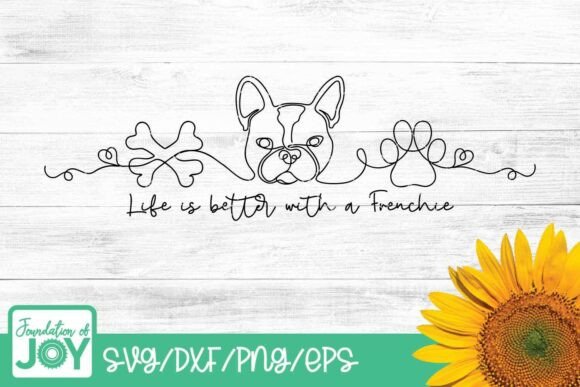
When I opened the Life is Better with a Frenchie, Line Art file set, my first thought wasn’t “cute”—it was “workable.” As someone who’s stitched hundreds of custom embroidery projects for Etsy sellers, boutique owners, and craft fair vendors, I scan designs for clarity before charm. This one delivers both: a confident, unbroken line drawing of a French Bulldog in profile, paired with clean, slightly playful sans-serif lettering. The negative space breathes. The curves are smooth—not overly tight or jagged—and the line weight stays consistent at around 1.5–2pt when scaled to standard hoop sizes. It feels like a design made *for* embroidery, not just adapted from a vinyl-cutting file.
Real-World Test: A Personalized Tote Bag for a Dog-Lover Client
Last week, I used Life is Better with a Frenchie, Line Art on a natural canvas tote for a local pet boutique’s holiday pop-up. We chose black thread on off-white fabric—simple, high-contrast, and instantly legible. The result? Crisp satin-stitched outlines, no skipped stitches or thread breaks, and zero fill-stitch bleed into the dog’s ear or the curve of the “B” in “Better.” Because it’s line art—not a dense vector illustration—it translated beautifully into running stitch for the outline and light fill for subtle shadowing (added manually, but easily). Customers paused mid-aisle. Not just to smile—they asked where to buy the design. That tells me this isn’t just decoration; it’s connection.
Where It Shines (and Where to Pause)
Life is Better with a Frenchie, Line Art excels on medium-to-heavyweight fabrics where stitch definition matters most:
- Tote bags & aprons: Holds shape well—even on textured canvas, thanks to its bold, open layout.
- Sweatshirts & hoodies: Reads clearly at 3.5"–4" wide without thin lines vanishing in the pile.
- Baby onesies & burp cloths: Gentle scale, no tiny details that snag or unravel after washing.
- Embroidered patches: Perfect for iron-on or sew-on versions—clean edges mean sharp heat-transfer results.
- Holiday gifts & nursery decor: Warm, inclusive tone works for dog moms, rescue volunteers, and even vet clinics.
But be thoughtful in these cases:
- Stretchy knits (like t-shirts): Use cutaway stabilizer and reduce top tension slightly—the line work stays true, but loose fabric can blur fine transitions if under-stabilized.
- Dark or heavily textured fabrics: The black-and-white PNG preview helps, but always test stitch on your exact fabric. Some weaves swallow 100% black thread; consider navy or charcoal for richer depth.
- Caps & curved surfaces: Avoid placing the full phrase across the front crown—it stretches the letter spacing. Instead, center the Frenchie alone, or use just “Frenchie” as a subtle side-embroidery accent.
- Small hoops (under 4"): The full phrase compresses well, but check the lowercase “e” and “a” in “Life”—they’re legible down to ~2.75", but don’t go smaller without verifying thread coverage.
What It Adds to Your Finished Product—Beyond Aesthetics
This isn’t just another graphic—it elevates perception. When customers see Life is Better with a Frenchie, Line Art stitched cleanly on a handmade pillow cover or baby blanket, they read “thoughtful,” “confident,” and “professionally made.” That builds trust faster than any product description. For Etsy sellers, it boosts perceived value: buyers pay more for items that look intentional, not clip-art-derived. And because the line art style avoids photorealism, it ages gracefully—no dated gradients or over-rendered shadows to date your shop listings.
It also supports brand consistency. Whether you’re selling embroidered tea towels under your own label or creating custom merch for a dog-walking business, Life is Better with a Frenchie, Line Art slots seamlessly into a cohesive visual language—minimalist but warm, modern but approachable.
Practical Designer Notes Before You Stitch
Even great files need smart execution. Here’s what I do every time—with Life is Better with a Frenchie, Line Art and every machine embroidery design I evaluate:
- Test on scrap fabric first—same fiber content, same wash/dry cycle you’ll use on the final piece.
- Check thread color contrast using both black and white mockups (the included 300 dpi PNG makes this fast).
- Review stitch density—this design runs light, but verify no overlapping satin columns in the dog’s ear or collar curve.
- Confirm hoop size compatibility—the SVG and EPS files scale cleanly, but always measure your final layout against your machine’s max hoop dimensions.
- Inspect small details—especially the dot in the Frenchie’s eye and the tail curl. They hold up well, but zoom in at 200% in your embroidery software.
- Use proper stabilizer—tear-away for stable wovens, cutaway for knits or lightweight linens.
- Verify licensing—the listing says “No resell” on the digital file, but confirms commercial use of finished embroidered products. Always double-check before uploading to POD platforms or bundling into design packs.
Final Thought: A Quietly Versatile Workhorse
Life is Better with a Frenchie, Line Art doesn’t shout. It doesn’t need glitter, shadow effects, or layered fonts to land. Its strength is restraint—and that’s rare in today’s oversaturated T-Shirt Designs category. It’s equally at home on a linen kitchen towel for a wedding gift, a cotton twill cap for a craft fair vendor, or a soft minky baby blanket sold through a small shop’s Instagram store. For embroidery designers and creative entrepreneurs, it’s less of a “trend” and more of a reliable, repeatable asset—one that stitches cleanly, sells consistently, and makes people pause, smile, and say, “Yes. Life *is* better with a Frenchie.”